
Cold Spin Closing vs Hot Spinning: Differences, Pros and Cons, and How to Choose
A metal tube end can be spin closed in two ways: cold spinning at room temperature, or hot spinning, where the tube end is heated first. Both close the end, but they differ a lot in power use, surface condition and what you can do with the part afterwards. This article compares the two so you can choose by tube material and downstream process.
 Cold spin-closed copper tube: no discoloration, no oxide scale |  Closed gas spring cylinders |  Stabilizer bar tube end closing |
The two methods
- Cold spin closing: the tube rotates at room temperature and a forming roller presses the end metal toward the center step by step. No heat is applied.
- Hot spinning: the tube end is heated to a high temperature to soften the material and is then spun closed.
Cold vs hot spinning
| Item | Cold spin closing | Hot spinning |
|---|---|---|
| Heating | None | Required before closing |
| Power use | Low | High, because of heating |
| Surface | No oxide scale; ready for machining and welding | Heating leaves an oxide scale that hinders machining and welding |
| Material properties | Unchanged, since there is no heat | High temperature changes the material properties |
| Tube requirements | The tube must be ductile enough; the seam of welded tube must be sound | Lower demands on the tube material |
When to choose cold spin closing
- The part will be welded, plated, painted or machined after closing and you do not want an extra descaling step.
- Copper or stainless tube must not discolor or anneal, as in heat exchangers and refrigerant tubes.
- Gas spring and shock absorber cylinders, where material strength matters.
- Power cost and cycle time matter.
When hot spinning is used
The advantage of hot spinning is that it asks little of the tube. It is needed when the tube is too hard or not ductile enough and would crack at the center if closed cold. The price is power use, oxide scale and changed material properties, and usually an extra cleaning step.
The tube is the key
Whether cold closing works depends mainly on ductility. The seam of welded tube must be sound, and cold-drawn tube is harder, so a sample trial is recommended. See “Which tubes can be spin closed?” for details.
What TONG DA builds
TONG DA closing machines (TD-31040, TD-31050, TD-21025 and the TD-382 NC servo machine) all close cold: no heat, no oxide scale, ready for the next operation. If you are not sure about your tube, send samples for a trial closing.
Related videos
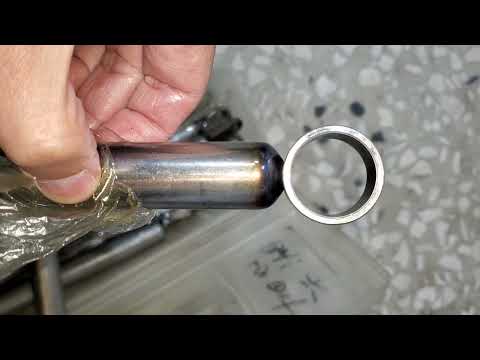 Spin-Closed vs Welded Tube End – Comparison | 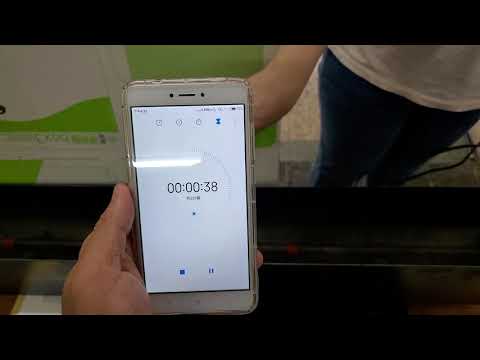 Hot-Water Leak Test of a Spin-Closed Tube End, 70 °C | 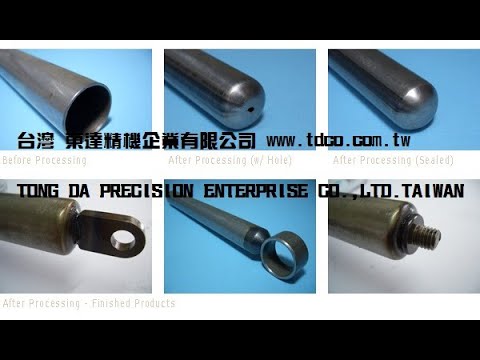 TD-31040 Gas Spring Cylinder Closing – OD15/18/21 on One Machine |
More machine videos on our YouTube channel: youtube.com/@closingmachine
FAQ
Is a cold-closed end strong enough?
The end is formed in one piece with the tube, with no weld seam, and the wall thickens naturally at the closure.
My tube is fairly hard. Can it be closed cold?
It depends on ductility. Send samples and we will report the result.
How do I ask?
Email tube OD, wall, material and the end drawing to sales@tdco.com.tw.